
PSTN Network vs VoIP and Mobile in India
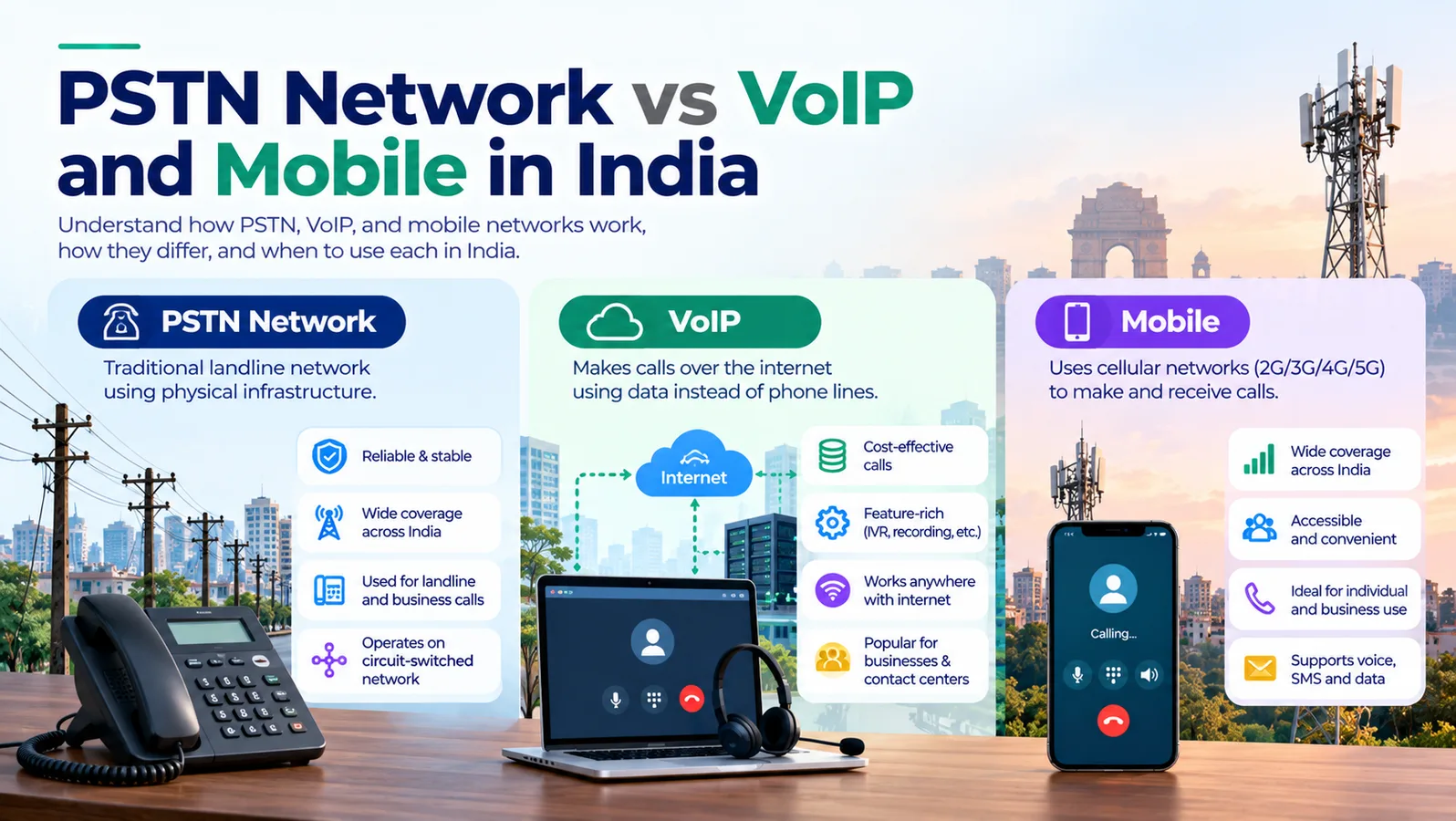
You dial a number and it rings somewhere else. What is pstn network is the system that makes that possible across operators and across fixed and mobile lines.
PSTN stands for Public Switched Telephone Network. It is not one company’s private switch. It is the aggregate of public networks joined so that any telephone can reach any other.
Quick Answer Box
PSTN is the public circuit-switched (and now often IP-carried) telephone network. A call reserves or routes a path between numbers. In India, BSNL is the main traditional fixed operator. Mobile networks interconnect with it. VoIP is usually cheaper and more flexible for businesses. Classic copper advantages have shrunk.
What Is PSTN Network and How Does It Work?
In the classic design the PSTN is circuit-switched. When you place a call, the network sets up a dedicated end-to-end path and holds it until someone hangs up. The historical digital voice channel is 64 kbit/s. That capacity belongs to the call even during silence.
Packet networks (VoIP) do the opposite: voice is chopped into packets that share links with other traffic. No path is reserved. That is why VoIP can be cheaper and why it must manage jitter and loss that circuit switching handled by design.
What is pstn call: is a call that uses this public numbered system. In supplier language, “PSTN termination” often simply means the ability to reach any public telephone number, fixed or mobile.
Important 2026 reality: many operators have retired or are retiring pure circuit-switched gear and carry the same calls over IP. The numbering plan, interconnection duties and the idea of the public telephone network remain. People still say “PSTN” for that public system even when the packets are IP.
A traditional landline is one service delivered over the PSTN. The network itself is the wider system of numbering, switching and interconnection.
Advantages of PSTN Network over VoIP Services in India
Historically:
Predictable voice quality without the customer managing jitter or bandwidth.
Traditional copper landlines often kept working during a local power cut (the line was powered from the exchange).
Emergency location was tied more simply to the physical line.
Less dependence on the customer’s broadband or power backup.
These advantages are narrower now:
Much voice, including mobile HD voice, already runs over IP inside the operator network.
Cloud and VoIP business numbers are the default for new Indian companies because they are cheaper, include IVR and recording, and work from anywhere.
Quality on a well-provisioned VoIP or mobile call is usually fine. Problems appear on poor broadband or congested links, which the business can measure.
Power resilience requires backup on the customer side for IP phones. A pure copper set did not.
For a new small business in India, the practical choice is almost always a cloud virtual number or SIP service that interconnects to the public network, not a new copper PSTN line. The PSTN advantage that still matters is simple reliability on an existing working landline where broadband is unstable. Even that is declining.
Which Companies Provide PSTN Network Services in India?
BSNL: the main traditional fixed-line (landline) operator and a mobile operator. Still the name most associated with classic PSTN landlines.
Bharti Airtel, Reliance Jio, Vodafone Idea (Vi): primarily mobile, with fixed broadband and voice products. Their networks interconnect with the fixed public network so calls complete both ways.
International carriers and wholesale providers that offer PSTN termination (the ability to deliver calls to Indian numbers).
No single company owns the PSTN. Operators interconnect. When your cloud provider says it can call any Indian mobile or landline, it is using interconnection into this public system, whether the last mile is circuit, mobile radio, or IP.
BSNL has also been deploying its own 4G and moving voice capabilities forward, so even the classic fixed operator is not standing still on pure legacy switching.
Difference Between PSTN Network and Mobile Networks in India
Point | PSTN (fixed public network) | Mobile (PLMN) |
Access | Traditionally copper or fibre to a fixed location | Radio to a handset that moves |
Classic switching | Circuit-switched path | Cellular core; interconnects to fixed |
Number | Geographic landline or non-geo | Mobile number |
Power | Old copper sets often worked in outages | Handset and tower need power |
Who runs it in India | BSNL mainly for classic landline | Jio, Airtel, Vi, BSNL |
Calls between them | Via interconnection | Same |
Mobile networks are public land mobile networks (PLMN). They interconnect with the fixed network so a landline can call a mobile and the reverse. In casual speech people sometimes say “PSTN” for any public number, including mobile. Strictly, mobile is the PLMN that joins the wider public telephone system.
A VoIP or cloud number is neither pure classic PSTN nor a mobile radio network. It is an IP service that uses public numbering and interconnects so it can call both.
What This Means for Business Voice
New IVR, auto-attendant and AI voice setups in India almost always sit on cloud telephony or SIP, not on a new circuit-switched line. Those services still complete calls to every PSTN and mobile number through interconnection. You get the reach of the public network without owning the copper.
Technical & Performance Data Matrix
Aspect | Classic PSTN | VoIP / cloud | Mobile (PLMN) |
Switching | Circuit, dedicated path | Packet, shared | Cellular + interconnect |
Quality management | Inherent | Must handle jitter/loss | Operator-managed |
Business features | Often extra | Usually included | App or operator add-ons |
Power cut (customer) | Copper set often survived | Needs backup | Handset battery |
India operator | BSNL landline | Cloud providers + interconnect | Jio, Airtel, Vi, BSNL |
New SMB choice | Rare | Default | For people, not systems |
Reach | Any public number | Any public number via interconnect | Any public number |
The matrix shows why cloud won for business systems. Reach is the same. Flexibility and price are not.
Interconnection is what makes a virtual number able to call a BSNL landline.
Advice vs Strategic Thinking Matrix
Decision | Generic advice | Strategic thinking |
What it is | Old landline | Public numbered network, circuit or IP-carried |
How it works | Wires | Dedicated path (classic) or packets that still use public numbers |
Versus VoIP | Always better quality | Quality edge has narrowed; VoIP wins on cost and features |
India providers | Only BSNL | BSNL fixed + mobile operators via interconnect |
Versus mobile | Completely separate | PLMN interconnects; calls complete both ways |
For business | Order a landline | Cloud number that reaches the PSTN |
Generic advice treats PSTN as the quality gold standard. Strategic thinking uses interconnection and measures the actual link.
People Also Ask
Q: What is the PSTN network?
The Public Switched Telephone Network: the interconnected public telephone system that lets any number reach any other.
Q: How does it work?
Classically by reserving a dedicated circuit for the call. Today much of the voice is carried as IP while numbering and interconnection stay.
Q: What is a PSTN call?
A call on the public telephone network, to or from a public number.
Q: Advantages over VoIP in India?
Historically more predictable quality and better power-cut behaviour on copper. For new business lines those edges are small. Cloud is usually the better choice.
Q: Which companies provide it in India?
BSNL for traditional fixed lines. Airtel, Jio, Vi and BSNL for mobile. All interconnect.
Q: Difference from mobile networks?
Mobile uses radio (PLMN) and interconnects with the fixed network. Calls between them work. Technology and access differ.
Q: Is VoIP part of the PSTN?
A VoIP service with public numbers interconnects with the public network. It is a different transport that reaches the same numbers.